
Municipal Planning Tribunal
17 August 2026
The Municipal Planning Tribunal (MPT) considers and decides certain land use and development applications in Cape Town. These decisions determine whether a development or land use can go ahead, and if so, under what conditions.
The MPT makes independent and objective decisions that are based on technical merit and the applicable law, such as the Municipal Planning By-law, the Development Management Scheme, and other City frameworks and policies such as the Municipal Spatial Development Framework, the eight District Spatial Development Frameworks, and Local Spatial Development Frameworks.
- The meetings of the MPT are open to the public. Any person can attend and observe these meetings, but only applicants and objectors may speak if they have requested the opportunity to do so beforehand. The agenda is available to the public, and the minutes of every meeting are published on the City’s website as soon as they are available.
- On average, about 14% of land use applications serve before the MPT for a decision. Generally speaking, these are administrative penalty applications and the most complex land use applications that are usually big in scale and rand value. The rest – approximately 86% of applications – are decided by the City’s Development Management planning professionals.
Council established the Municipal Planning Tribunal on 25 March 2015 under report reference C36/03/15 in terms of section 115(1) of the City of Cape Town’s Municipal Planning By-Law.
The Municipal Planning Tribunal is operates in four regional panels, each serving a geographic area of the city, namely:
- North Western
- North Eastern
- South Eastern
- South Western
View the map indicating the areas.
The panels usually meet monthly to deal with cases and applications applicable to their geographic area.
Municipal Planning Tribunal meetings
Meeting dates, times, venues, agendas, minutes and resolutions are published on the Council calendar.
- Members of the public and the media may observe a meeting.
- Applicant(s) and objector(s) may request to make an oral submission at the meeting, but a written request must be submitted at least five days before the meeting.
- Requests for oral submissions are considered in terms of the Municipal Planning By-law and its procedures.
How to attend a virtual meeting
Those who wish to attend, speak or make representations at a virtual Municipal Planning Tribunal meeting should follow the participation instructions published with the relevant meeting information. These instructions require advance registration and confirmation from the Tribunal Secretariat. To contact the secretariat, send an email to MPT.OralHearings@capetown.gov.za.
View Municipal Planning Tribunal meeting dates, agendas and minutes.
Municipal Planning Tribunal members
Council appoints the members who serve on the Municipal Planning Tribunal. These members are senior City officials and external members who are independent built environment professionals, as prescribed by the Spatial Planning and Land Use Management Act (SPLUMA).
The table below provides details about the appointment date and term of current members, as well as when the appointments were published in the Provincial Gazette:
| Name | Appointed by Council on | Term ends on |
Notice of appointment published in the Provincial Gazette (as required by section 115(10) of the Municipal Planning By-Law) on |
|---|---|---|---|
| Dave Daniels (Chairperson) | 30 October 2025 | 30 June 2030 | 7 November 2025 |
| Sydney Holden (Deputy Chairperson) | 30 October 2025 | 30 June 2030 | 7 November 2025 |
| Rodney Cronwright | 30 October 2025 | 30 June 2030 | 7 November 2025 |
| Wally Johnson | 30 October 2025 | 30 June 2030 | 7 November 2025 |
| Pierre Smit | 30 October 2025 | 30 June 2030 | 7 November 2025 |
| Richard Walton | 30 October 2025 | 30 June 2030 | 7 November 2025 |
| Louise Seaward | 30 October 2025 | 30 June 2030 | 7 November 2025 |
| Christine Havenga | 30 October 2025 | 30 June 2030 | 7 November 2025 |
| Emil Schnackenberg | 30 October 2025 | 30 June 2030 | 7 November 2025 |
| Daan Visser | 30 October 2025 | 30 June 2030 | 7 November 2025 |
| Susanna Matthysen | 30 October 2025 | 30 June 2030 | 7 November 2025 |
| Marx Mupariwa | 30 October 2025 | 30 June 2030 | 7 November 2025 |
| Gideon Brand | 30 October 2025 | 30 June 2030 | 7 November 2025 |
| Nigel Titus | 30 October 2025 | 30 June 2030 | 7 November 2025 |
| Danette de Klerk | 30 October 2025 | 30 June 2030 | 7 November 2025 |
| Elmari Marais | 30 October 2025 | 30 June 2030 | 7 November 2025 |
| Dewaldt Smit | 28 May 2025 | 30 June 2030 | 13 June 2025 |
| Linah Dube | 28 May 2025 | 30 June 2030 | 13 June 2025 |
| Chad Newman | 28 May 2025 | 30 June 2030 | 13 June 2025 |
| Dimitri Georgeades | 28 May 2025 | 30 June 2030 | 13 June 2025 |
| Craig Alexander | 28 May 2025 | 30 June 2030 | 13 June 2025 |
| Bradley Burger | 28 May 2025 | 30 June 2030 | 13 June 2025 |
| Annelise de Bruin | 28 May 2025 | 30 June 2030 | 13 June 2025 |
Applications decided by the Municipal Planning Tribunal
Council prescribes which categories of land use applications are decided by the Municipal Planning Tribunal and those to be decided by an authorised City official.
As per Council decision of 27 March 2024, these are as follows:
Category 1: Applications decided by the Municipal Planning Tribunal
1.1 Amendment, suspension or removal of a restrictive title deed condition
1.2 Any other application provided for or prescribed in terms of the Municipal Planning By-law in future
1.3 Rezoning
1.4 Subdivision, including a phased subdivision
1.5 Land consolidation
1.6 Consent, approval, or other permission in terms of the Development Management Scheme
1.7 Consent or approval in terms of, or relaxation of, a restrictive title deed condition where the restriction relates to use, subdivision, development rules or design criteria
1.8 Permanent departure
1.9 Temporary departure
1.10 Amendment, deletion or addition of conditions relating to an existing approval
1.11 Applications where the delegated official elects not to exercise the delegated power
1.12 Determination of an administrative penalty, including where the penalty is considered together with the land use application or applications required to rectify the contravention
Category 2: Applications decided by an authorised City official
2.1 Applications in categories 1.1 to 1.5 above where there are no objections from the general public
2.2 Applications in categories 1.6 to 1.10 above where no administrative penalty is considered and decided together with the land use application or applications, and the proposal is consistent with Council-approved policy.
2.3 Subdivision phasing
2.4 Exemption of a subdivision from approval in terms of the Municipal Planning By- Law.
2.5 Extension of the period of validity of a previous approval
2.6 Permission or approval required in terms of the conditions of approval of an application
2.7 Correction of a zoning map error
2.8 Determination of zoning, a non-conforming use right or any other matter that the City may determine in terms of the Municipal Planning By-law
2.9 Approval, alteration or amendment of a street name or number where a correction is required
2.10 Amendment or cancellation of an approved plan of subdivision or general plan
2.11 Permission to reconstruct a building, or a substantial part of it, within the envelope of a non-conforming use
2.12 Approval for construction on a land unit forming part of an approved subdivision before the subdivision, or relevant phase of the subdivision, has been confirmed, as contemplated in section 55(4)(b) of the Municipal Planning By-law
MPT resolutions and minutes
The Council calendar publishes item resolutions and confirmed meeting minutes as soon as they are available. When accessing the Council calendar, open the relevant meeting to find the matter by case ID, erf number, address or agenda item number.
A published resolution or minutes is a public record of the MPT’s decision; however, it is not the formal decision notice. The formal notice to applicants and objectors (if any) sets out the decision, reasons, any conditions, and the available appeal rights and deadlines.
- The City notifies the applicant(s) and any objector(s) in writing. The notice explains the outcome and any right of appeal.
- The appeal period takes effect on the notification date that is stipulated in the decision letter that is sent to the applicant(s) and objector(s).
- If a valid appeal is lodged on time, the MPT’s decision is suspended until the appeal has been decided.
PLEASE NOTE
- The Municipal Planning Tribunal does not decide every land use application as it depends on the application category, whether objections were received, and other circumstances set out in the Council-approved prescription.
- Applicants should refer to their application correspondence for information about the assessment and decision process.
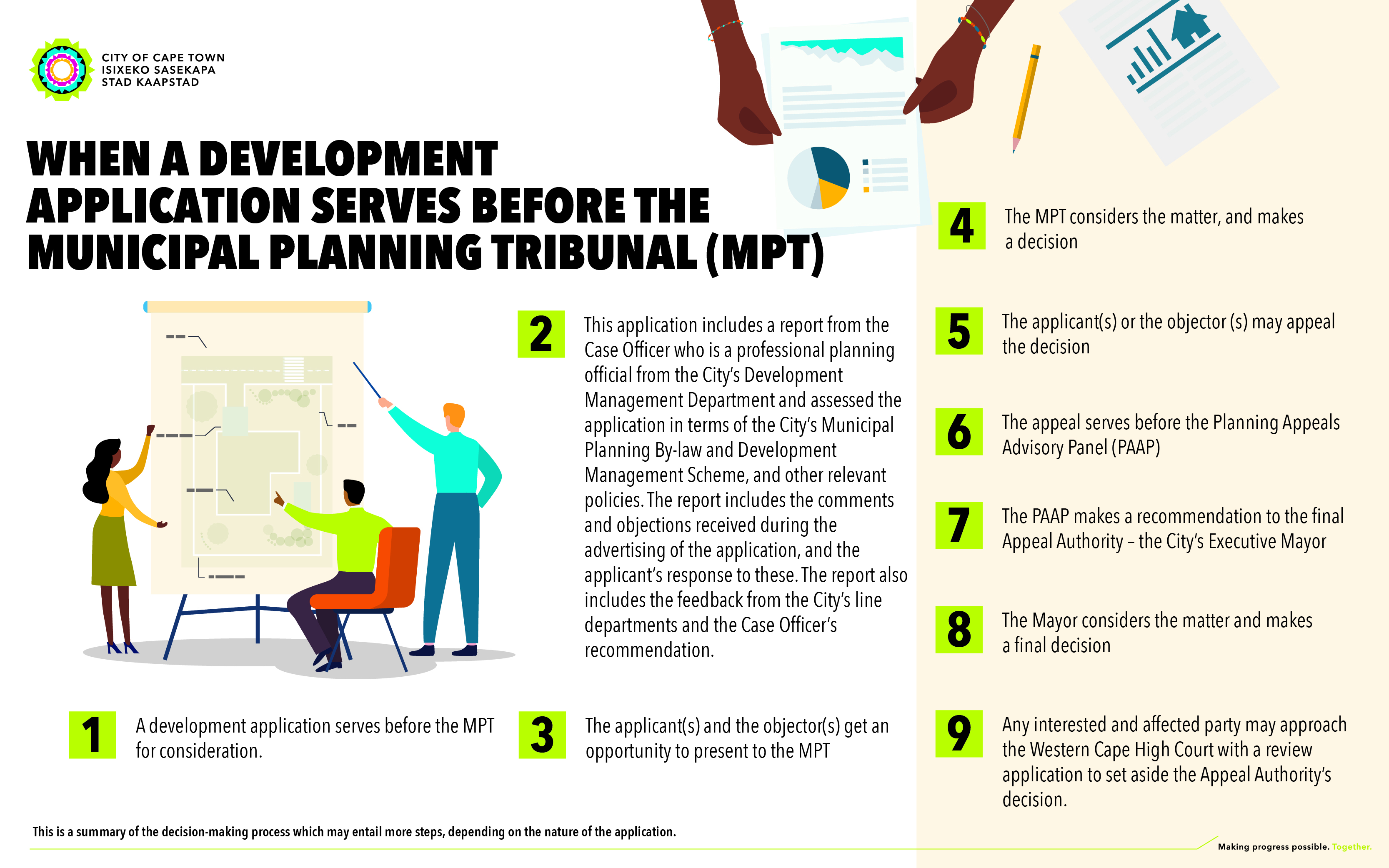
- The MPT’s decisions may be appealed by the applicant(s) or the objector(s). In these cases, the MPT decision is suspended until the Planning Appeals Advisory Panel (PAAP) has made a recommendation to the final Appeal Authority, and the final Appeal Authority has made a decision and informed the applicant(s) and objector(s).
- In terms of the Municipal Planning By-law, the City’s Executive Mayor is the final Appeal Authority.
- Should an interested and affected party be unhappy with the final outcome, it may approach the Western Cape High Court for a review of the decision.
For more information
- Contact your local Development Management district office.
- Review the decision or application correspondence issued by the City.
- Consult a registered planning professional where appropriate.
You may want to
Find out about land use applications
Find out about the Municipal Planning By-law
Read about the Development Management Scheme
Contact the Development Management district offices
Read our Municipal Planning Tribunal Q&A